EN
EN
 AR
AR
 BG
BG
 FR
FR
 DE
DE
 HI
HI
 IT
IT
 JA
JA
 KO
KO
 PT
PT
 RO
RO
 RU
RU
 ES
ES
 TL
TL
 IW
IW
 ID
ID
 LV
LV
 LT
LT
 SR
SR
 SK
SK
 SL
SL
 UK
UK
 VI
VI
 SQ
SQ
 GL
GL
 HU
HU
 MT
MT
 TH
TH
 TR
TR
 AF
AF
 GA
GA
 BE
BE
 MK
MK
 HY
HY
 AZ
AZ
 KA
KA
 BN
BN
 BS
BS
 LO
LO
 MN
MN
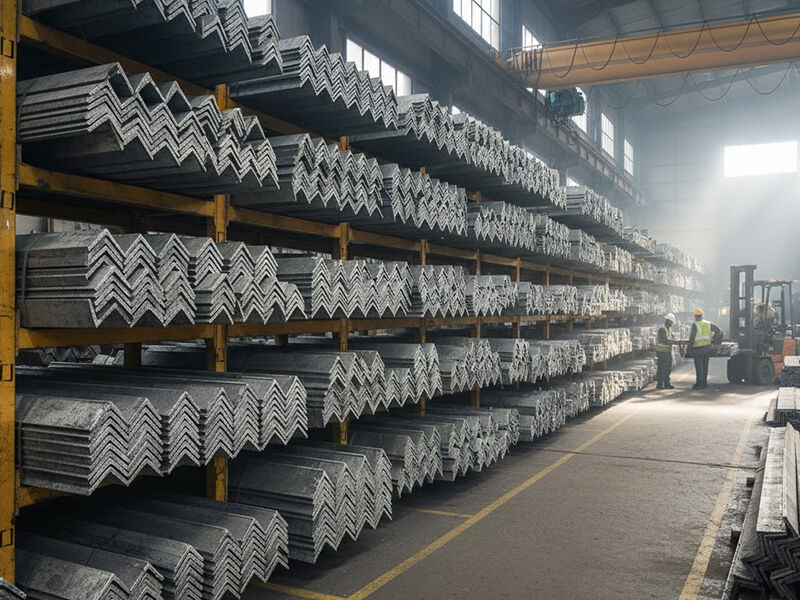
Angel steel or L-bar is one of the most basic and popular construction materials, which is known as galvanized angle steel. It has an L shaped cross-section that gives it great strength and rigidity in framing, bracing, support, and structural uses. Though the core strength is provided by the steel itself, it is the zinc coating, which is provided by galvanizing process, which determines its long term value and life. This coating prevents corrosion of the base steel and increases structure life significantly even in harsh conditions. It would be important to understand the standards and specifications involved in this galvanizing in order to make the right choice of product to use in your project.
The Galvanizing Process: Hot-Dip Dominance
Hot-dip is the most popular and productive process of galvanizing angle steel. It is a process of set stages:
Surface Preparation: The steel angle is washed in alkaline solutions, pickled in acid to remove mill scale and rust and fluxed to prevent oxidation prior to dipping.
Galvanizing: The already pre-prepared angle is placed into a vessel of molten zinc (usually between 450degC / 840degF).
Metallurgical Bonding: A metallurgical bond takes place between the iron and zinc and results in a number of zinc iron alloy layers topped by a layer of pure zinc.
Cooling: The angle is removed and allowed to cool, producing a coating which is closely bonded and protective.
This is done to make sure that it covers all parts of the angle even edges and corners, which is usually the most susceptible to corrosion.
Key Specifications and Standards
In the specification or purchase of galvanized angle steel, there are a number of critical standards that establish the quality of the base steel as well as the coating.
1. Base Steel Specifications: The standards of the steel angle mechanical and chemical properties are controlled by:
ASTM A36/A36M: This is the standard specification of carbon structural steel used in general construction as an angle, and in bolting, riveting, or welding.
ASTM A572/A572M: This is a high-strength low-alloy columbium-vanadium structural steel, whose yield strength is higher than A36.
GB/T 706 (China): Chinese standard of dimensions, shapes, weight, and tolerances of the hot-rolled steel sections, as well as angles.
JIS G 3192 (Japan): Dimensions, weight and tolerances of hot-rolled sections of steel.
2. Galvanizing Coating Standards: There shall be no fewer than 3 stages of galvanizing coating.
These are the most essential criteria of measuring the corrosion protection.
ASTM A123/ A123M: Standard Specification Zinc (Hot-Dip Galvanized) Coating on Iron and Steel products. This is the ultimate criterion in North America. It has the following important requirements:
Minimum Coating Thickness/Mass: The specification establishes minimum values depending on the thickness of the steel. As an example, steel with a thickness of more than 6mm should have an average mass of coating of at least 610 g/m2 (which corresponds to the average thickness of about 85 microns). The finer steel must be coated heavier.
Adherence (Ductility): The coating should undergo a test (such as the "quench" test) to show that it does not flake or peel away off the underlying steel.
Appearance: Though the spangled look is usually uniform, coating continuity and absence of uncoated areas is obligatory.
Hot-dip galvanized coating of manufactured iron and steel objects - Specifications and test methods (ISO 1461). This is the major international standard. Like ASTM A123, it defines minimum masses of coating by thickness of material and type of steel, giving an international standard.
AS/NZS 4680 (Australia/New Zealand) and EN ISO 1461 (Europe): These regional standards are more or less consistent with the principle of ISO 1461, and guarantee the soundness of coating requirements.
3. Weight/Thickness Measurement Coating:
The thickness of the coating (measured in microns, mm) or the mass of the coating per square meter (g/m 2) is the direct measure of the level of protection. This is checked by means of non-destructive magnetic thickness gauges or by laboratory stripping tests (ASTM A90). The greater the mass of the coating, the longer will be its probable service life.
Factors Influencing Coating Life and Selection
Environment: Zinc has a varied corrosion rate. An average coating in the country will have a lifetime of decades, whereas an equivalent coating in the industrial or marine (salt-spray) environment will have a lower life. In hostile conditions, it is important to state heavier coating (HDG).
Steel Chemistry: The presence of silicon and phosphorus in the base steel (so called, steel reactivity) has the potential to influence coating thickness and appearance which may result in very thick and darker gray coatings that remain completely protective.
Fabrication Considerations: ANGLE should be galvanized once all cutting, drilling and welding (fabrication) is done. In case we need to do post-galvanizing welding, the zinc strip that was damaged should be repaired using a high content of zinc paint to ensure that it provides corrosion protection.
Conclusion: The Value of Specification Compliance
Galvanized angle steel is not a mere steel bar, but an array of corrosion protection which is part of the life span and integrity of construction such as transmission towers, industrial frames, farm buildings and warehouse shelves. Defining and confirming compliance with established standards such as the ASTM A123 or the ISO 1461 is not a mere formality--it is a very essential quality assurance measure. It guarantees you a product that has a tested and with long-lasting coating that will deliver as desired in the field.
Shandong Runhai Stainless Steel Co., Ltd. is one of the companies that has guaranteed supply of products of galvanized steel that are specification-compliant, such as a complete line of galvanized angle steel, designed to be used in the project where consistent supply is required. We keep complete stock of carbon angle steel,stainless angle steel and galvanized steel product line, and our modernized warehouse and logistic system allows the company efficient handling and delivery of materials. As suppliers of various segments of construction and power, to chemical infrastructure we are in a position to assist your project requirements with quality materials supported by excellent technical and supply chain alliances.